At what point does an official message stop being authoritative? Can an informal mark become more powerful than an official sign?I was inspired by Clet Abraham1, who takes existing signs whose meanings are already understood and adds a small intervention that changes or questions the message. The original sign remains recognisable, but the added element makes the viewer reconsider it. I also looked at MOBSTR2, whose interventions more directly subvert public messaging and signage. His work feels more confrontational, using playful contradiction as a form of social criticism.
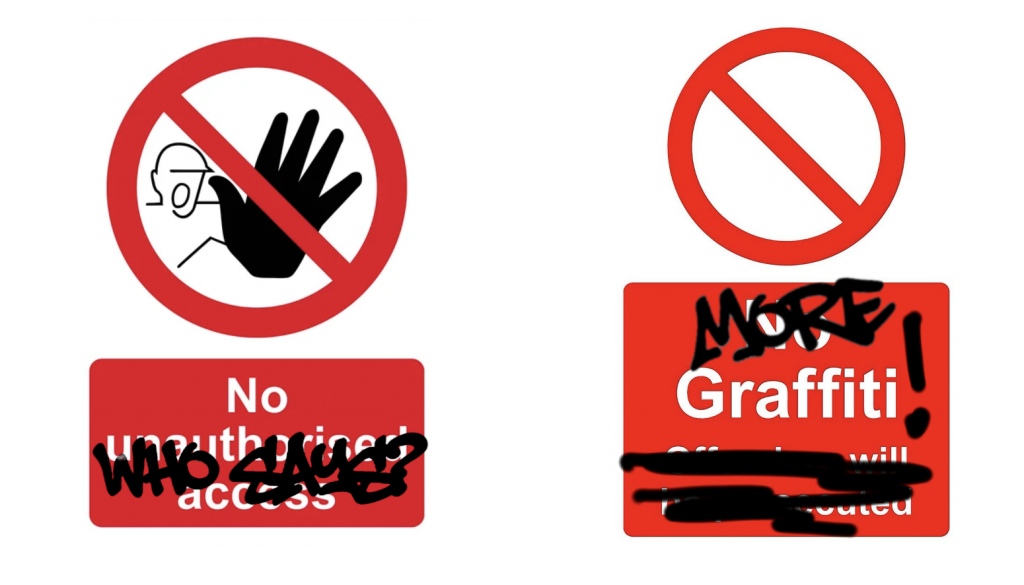
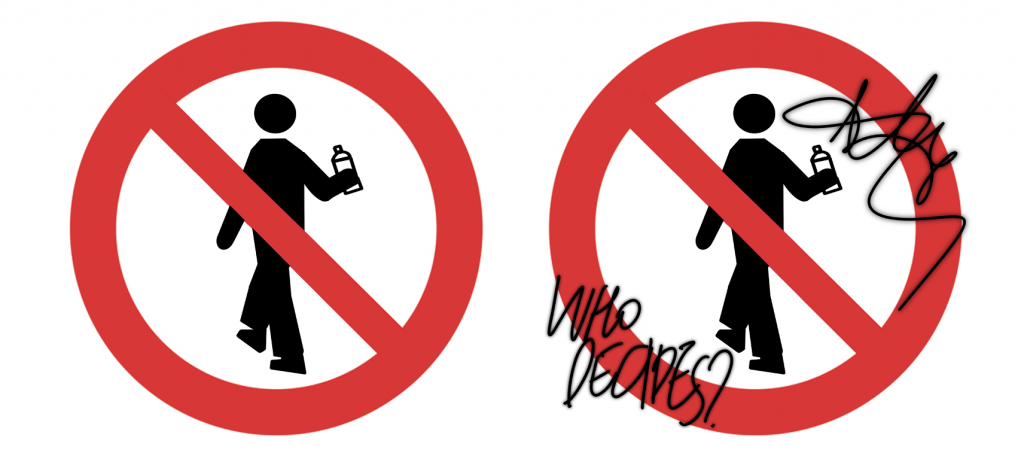
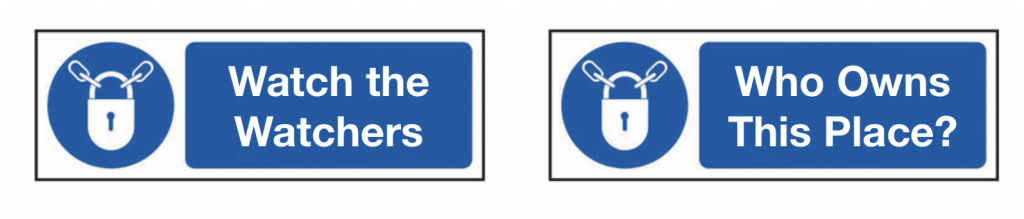
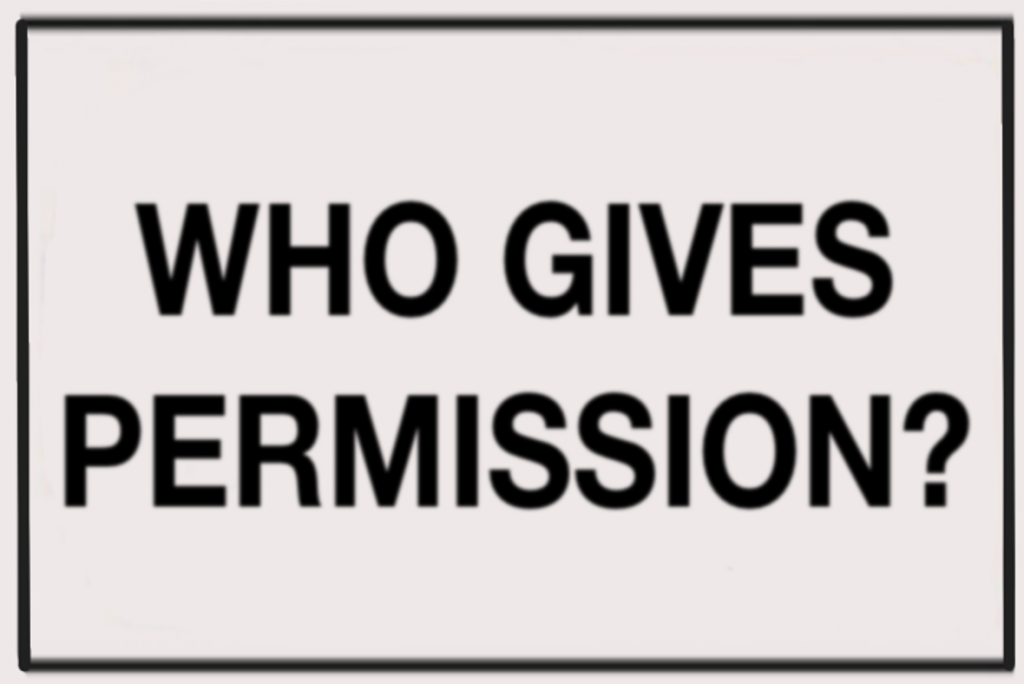
I created my own interventions using familiar sign formats and messages connected to the estate. On an “NO AUTHORISED ACCESS” sign, I added the handwritten question “WHO SAYS?” I changed “NO GRAFFITI” by crossing out “NO” and replacing it with “MORE”, with additional crossed-out text below. I made a “WE ARE WATCHING YOU” sign with an all-seeing-eye triangle above it, and blue-and-white signs reading “WATCH THE WATCHERS” and “WHO OWNS THIS PLACE”. I also made a white rectangle with black text asking “WHO GIVES PERMISSION?” and my own no graffiti sign, and added ‘graffiti’.
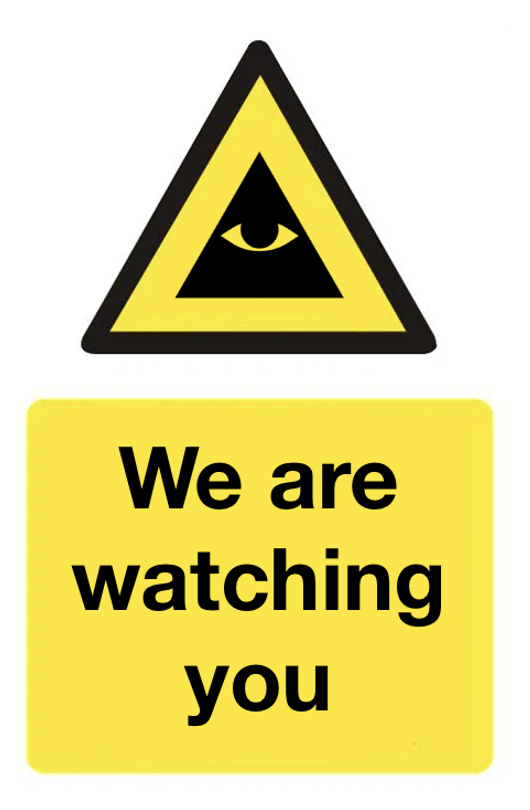
My favourite intervention was “WE ARE WATCHING YOU”, particularly because of the eye symbol I added to it. Before this intervention, the sign communicated that CCTV was in operation, presenting surveillance as an official and impersonal system of control. By introducing the eye, I wanted to make that message feel more direct and personal. The eye becomes a visual representation of the watcher, turning an abstract system of surveillance into something that appears to look back at you.
I liked this intervention because it changes the emotional quality of the original message without removing its authority. The sign already tells people that they are being watched, but the eye makes that feeling more immediate. It also raises a question about who is watching, who has the power to observe, and how much control people have over their own visibility in a public space. The eye can be read as a symbol of surveillance, but it also makes the act of watching itself visible. Rather than simply repeating the warning, the intervention draws attention to the power behind it.
FINDINGS !
The interventions did not necessarily remove the authority of the original signs, but they disrupted it and changed how I read it. “NO AUTHORISED ACCESS” initially appears definitive; adding “WHO SAYS?” turns it into a question about who has the power to make and enforce the rule. “WHO GIVES PERMISSION?” similarly shifts attention from the instruction itself to the authority behind it.
The “NO GRAFFITI / MORE GRAFFITI” intervention was particularly interesting because the method became part of the response: I used graffiti to challenge a rule that explicitly prohibits it. Rather than simply replacing one message with another, the intervention creates a contradiction that the viewer has to resolve.This connects back to my earlier observations of fences, CCTV, locks and signage. These elements all communicate rules about how people should move and behave within the estate. My interventions introduce a second voice into this system—one that questions rather than simply follows the instructions. The official sign is still visible, but its message no longer feels entirely closed or
[add pics here on on site]
The feedback I received was that my interventions needed to be shown in their actual environments, rather than presented digitally on plain white backgrounds. Although the digital versions allowed me to focus on the message and experiment with different visual treatments, they did not reflect how the interventions would be experienced in real life. In the actual environment, they would interact with existing architecture, signs, textures and surrounding activity. Their placement and relationship to the site would influence how people read and respond to them.
In response to this feedback, I returned to the estate and placed my interventions within the existing environment. I positioned “WE ARE WATCHING YOU” beside the estate intercom, connecting the message of surveillance to an actual point of controlled access. This placement made the intervention more relevant to its surroundings, as the intercom already represents a system through which entry is managed. The message therefore became part of a wider conversation about surveillance, access and control, rather than an isolated graphic.
I also placed “MORE GRAFFITI” on the mural, allowing it to interact directly with an existing piece of authorised visual communication. This developed the original idea further by bringing my intervention into contact with the mural’s imagery and message. I changed the design and introduced my own typography, rather than relying on the typeface I had previously found on DaFont. This allowed me to make the lettering more personal and to consider how the typographic style could affect the tone of the message. It also moved the work away from a purely digital experiment towards something that responded more directly to the character of the site.
By placing these interventions in context, I could begin to explore how their meanings changed through location. The intervention was no longer just about what the words said, but also where they appeared and what they were challenging. Beside the intercom, “WE ARE WATCHING YOU” reinforced questions about surveillance and controlled access; on the mural, “MORE GRAFFITI” challenged the boundary between authorised expression and unauthorised marking. This helped me understand that the physical environment is not simply a background for the work, but an active part of how the message is communicated.
How might these overlapping instructions, boundaries and acts of resistance be translated into another format, such as a rulebook, interface or game?
- Berton, E. (2015). Turn left … for love: Clet Abraham’s hacked street signs – in pictures. [online] the Guardian. Available at: https://www.theguardian.com/cities/gallery/2015/may/21/clet-abraham-hacked-street-signs-in-pictures [Accessed 10 Oct. 2026]. ↩︎
- Urban Nation. (n.d.). Mobstr. [online] Available at: https://urban-nation.com/artist/mobstr/ [Accessed 10 Oct. 2026]. ↩︎
Leave a Reply