
What does the relationship between the mural and the graffiti say about the estate, and whose voice gets to communicate on a shared wall?I annotated the mural and the graffiti that appears on its surface, looking at the difference between the mural’s planned composition and the more informal marks layered over it. I considered how each communicates, how the two forms of mark-making occupy the same surface, and what their coexistence might suggest about the way the estate is represented and used.
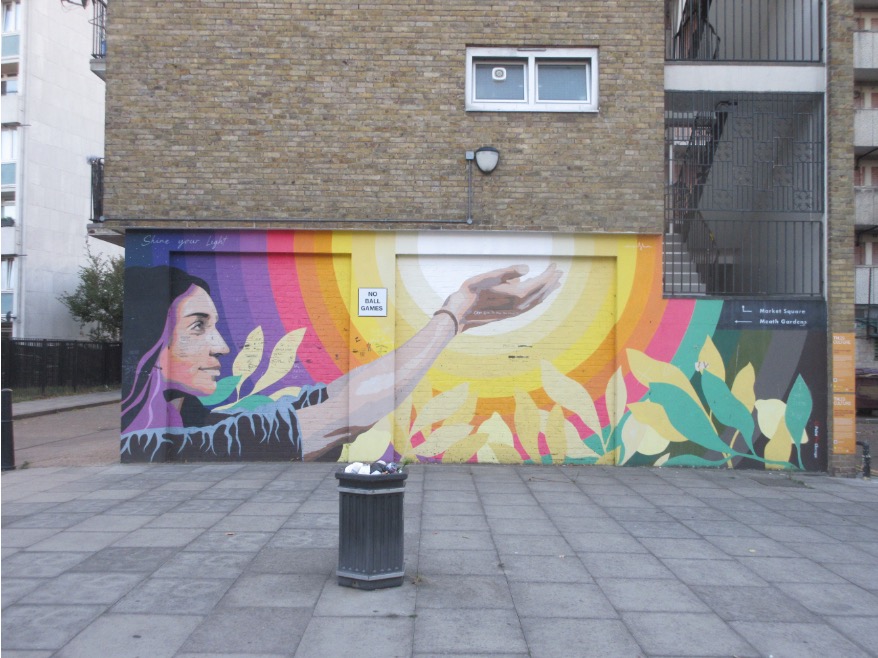
The Usk Street mural was created through a community arts project led by Streets of Growth and artist ATMA, working with female students from Central Foundation Girls’ School in Bow1. The students helped co-design the artwork, and local residentsand young people were then invited to take part in painting it. The project was intended to bring colour, life and a sense of the natural environment to the estate, with the stated aim of creating positivity and optimism. It was funded by Tower Hamlets Council’s High Streets Team and commissioned as part of improvement works connected to Roman Road.
So the mural is technically community-involved, but it is also organised, commissioned and designed. It is trying to improve the environment through a deliberate visual intervention:
COLOUR + DESIGN + COMMUNITY PROJECT = POSITIVE IMAGE OF PLACE
The mural therefore communicates something quite specific about how the estate should feel: colourful, positive, creative, natural and community-oriented.
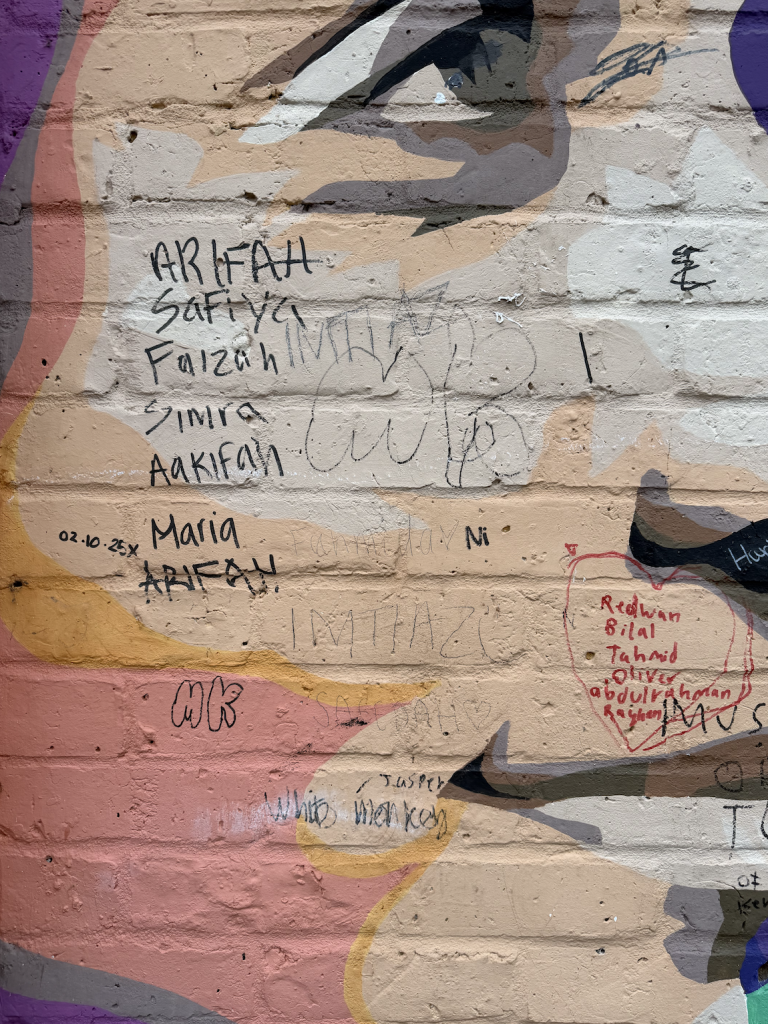
The mural creates a controlled visual composition: large areas of colour, consistent shapes and a clear overall aesthetic. The graffiti introduces something much less controlled: names / initials / dates / hearts / drawings / crossed-out marks / messages. Instead of one coherent public artwork, the wall becomes a layered record of different people using the surface.
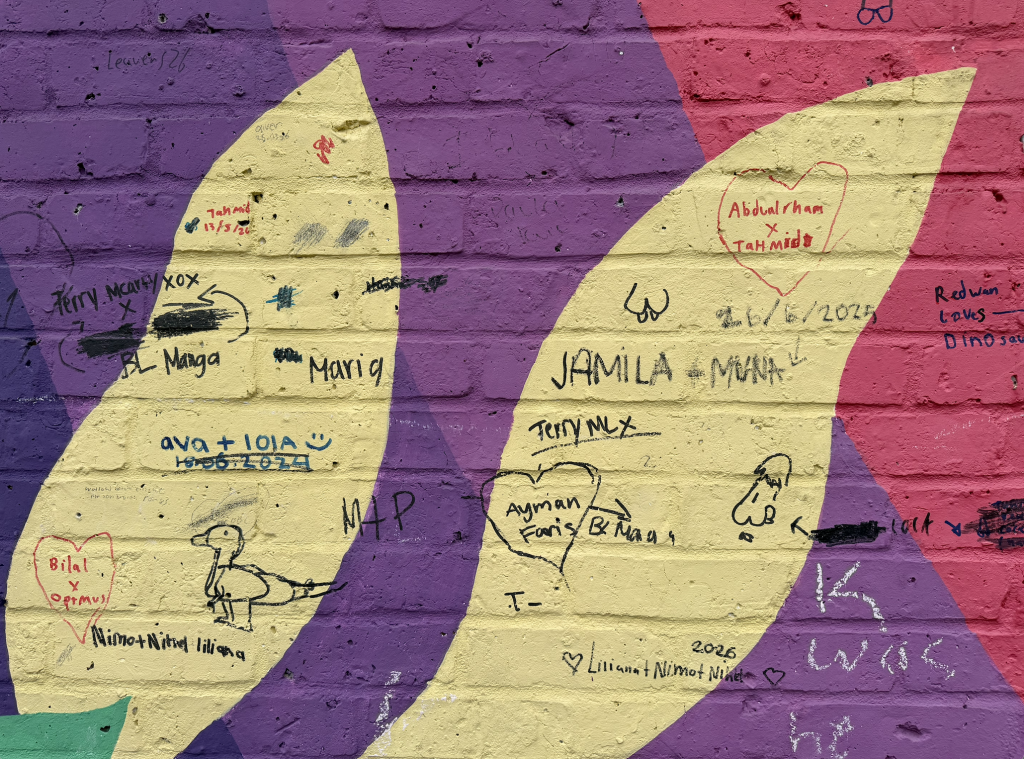
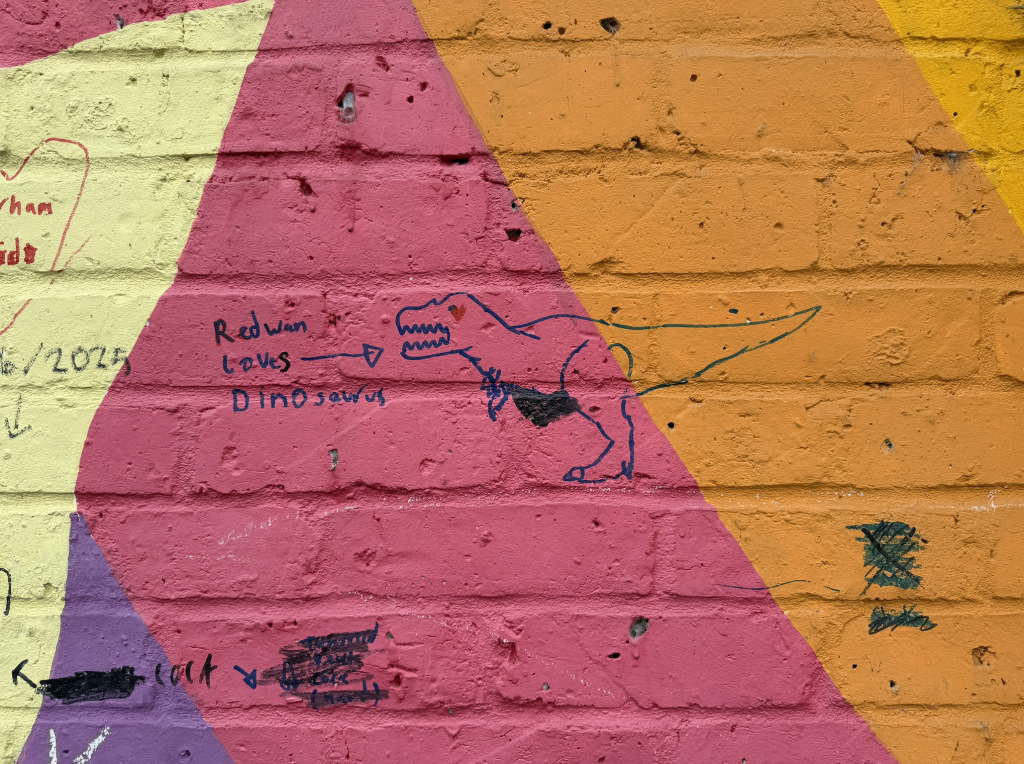
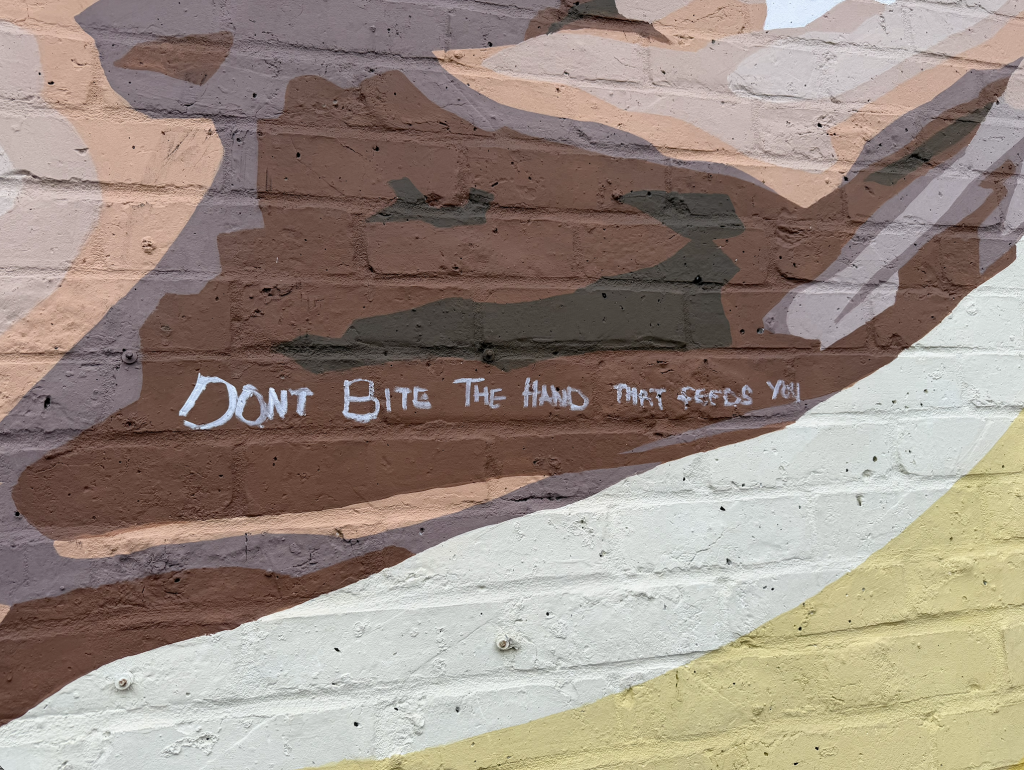
PERSONAL CLAIM: Names, initials and dedications turn a public wall into a surface for individual expression and social interaction.
LAYERING / ACCUMULATION – The graffiti does not replace the mural. It sits on top of it, creating layers of different authorship.
LAYERED SURFACE: The wall records repeated acts of use. Each new mark adds to an evolving visual history rather than maintaining a fixed composition.
The mural says: THIS WALL HAS BEEN DESIGNED
The graffiti says: THIS WALL IS BEING USED
UNCONTROLLED GRAPHIC LANGUAGE: The informal handwriting disrupts the mural’s organised visual system, introducing spontaneous and individual forms of communication.
DESIGNED GRAPHICS with Unauthorised Graphics – they both communicate, but through completely different systems.
PUBLIC / PERSONAL: Although the wall is public, some of the markings appear to contain very personal communication intended for specific people.
Interesting contradiction – Private Messages on a Public Surface
YOUTH CONTEXT: The proximity of a secondary school makes the wall part of an environment used by young people. The personal names, drawings and messages could therefore be read as informal forms of youth communication, although authorship cannot be confirmed.
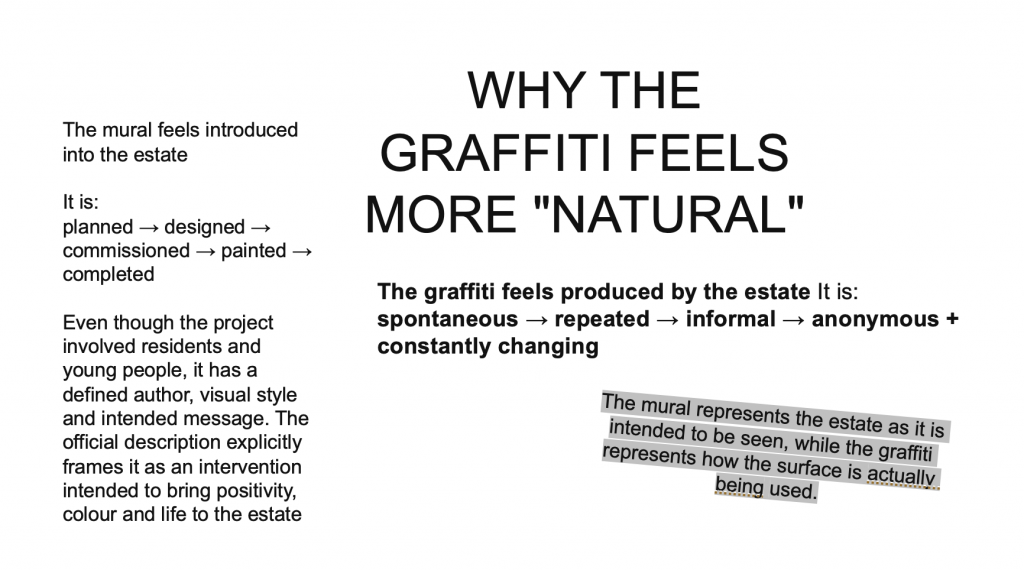
The wall therefore becomes a meeting point—and sometimes a conflict—between an AUTHORISED VOICE and an UNAUTHORISED VOICE. Another way to describe this is DESIGNED IDENTITY versus LIVED IDENTITY. The distinction is not completely simple: a community mural can involve local people and still have a planned visual language, while graffiti can be personal and spontaneous without necessarily representing everyone who uses the estate. My observation is about the different ways the two forms communicate, rather than claiming that one is automatically more authentic than the other.
If an informal mark can alter how I read a designed wall, can I use similar interventions to question the authority of official signs?
- Streets of Growth (2023). Shine Your Light. [online] Streets of Growth. Available at: https://www.streetsofgrowth.org/news/2sw4wu7gbwe9ptw0jme8tvhh2i0xl9 [Accessed 9 Oct. 2026]. ↩︎
Leave a Reply