For this unit I had to choose a tool or medium I’m not experienced with, copy someone else’s project made with it, and use the process to find a critical question I could develop through iteration. I chose cross-stitch, because it’s a slow, structured, hand-made process that works a lot like a pixel grid, and I wanted to see what happens when that process is laid over an existing image. I copied a piece by @izzy.cuzzy on tiktok, in which cross-stitch is worked over a photograph. This post covers the copy, the questions it raised, and my first draft of writing.
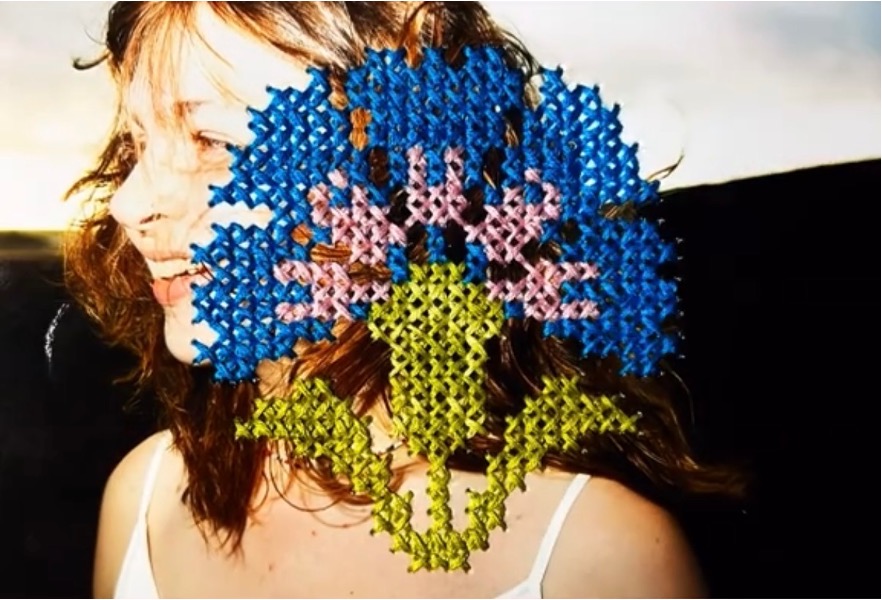
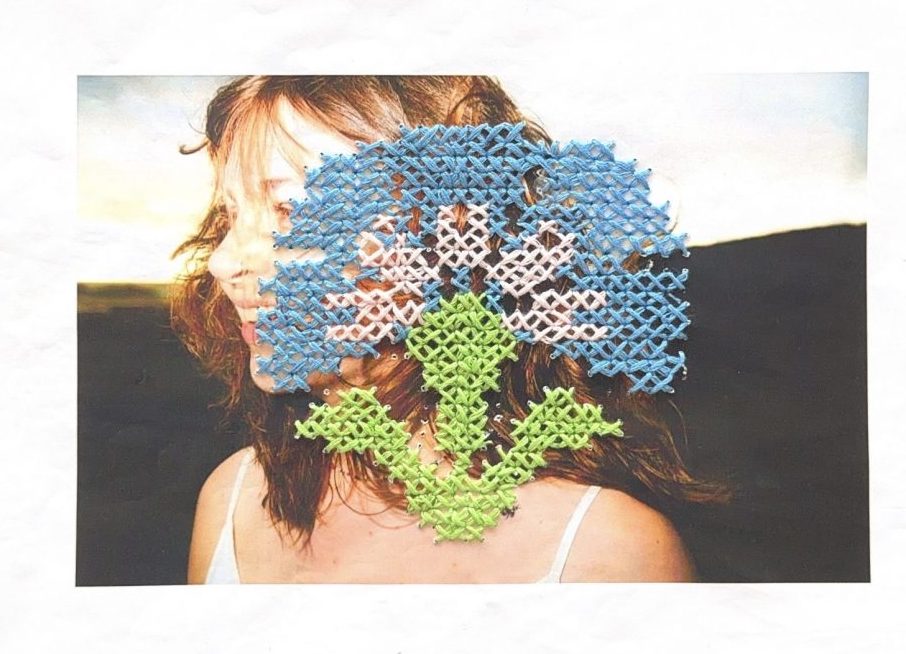
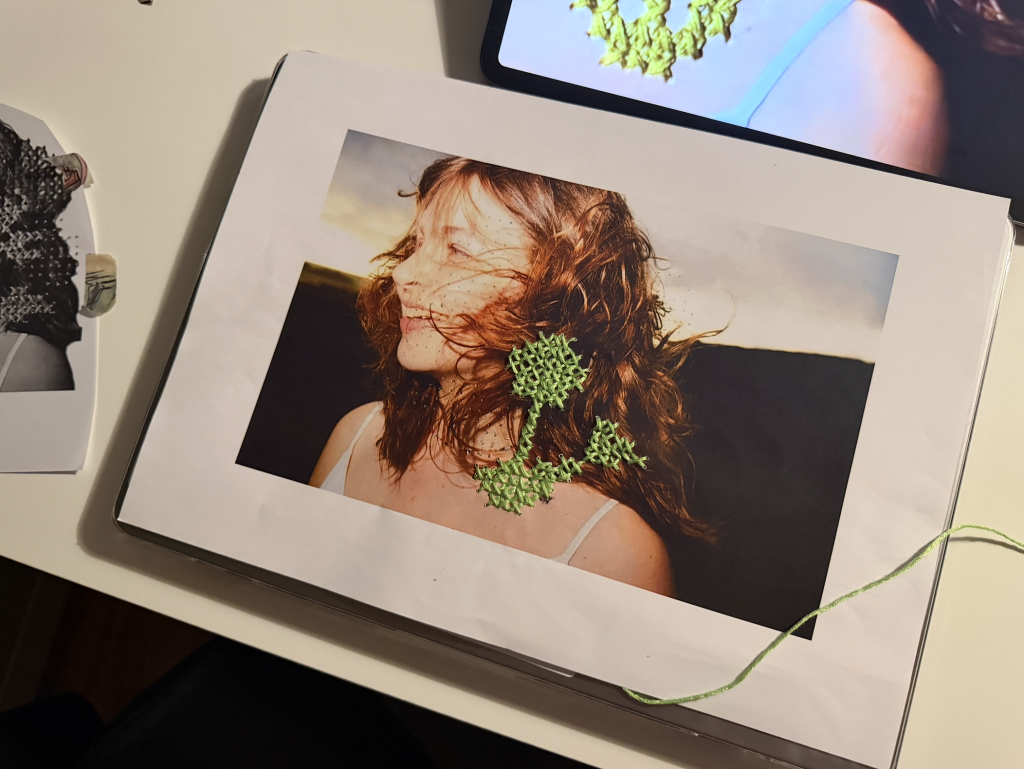
Original work (left) and my piece (right)
I worked on paper, mostly freehand, and tried to match the placement and spacing of the original stitches as closely as I could without knowing how the artist had planned it – I went more freehand, and placed the holes as I went along. I also found their original image, and edited it as best as I could so it matched the original.
What I found out (the five brief questions)
1. What’s unexpected about what you made?
I found it harder than expected to copy the original accurately. I was working quite freehand, whereas the artist’s finished work looks much more planned and deliberate. Even small differences in stitch placement, spacing and alignment changed how cohesive the final image looked.
2. What do I understand differently about the medium?
I started out trying to recreate the visual appearance, but I learnt that the process and the material affect the outcome just as much. Working on paper meant I had to be careful with the placement and tension of the stitches, because the paper could rip. A more fixed plan would have helped the stitches feel more consistent.
3. Did it pose a technical challenge?
Yes. The main challenge was translating an existing image into a physical process without knowing exactly how the artist had planned or executed it. I had to make decisions as I went along, which made consistency difficult. The paper was fragile, so the material limited how freely I could work.
4. What kind of output or knowledge does this medium favour?
Cross-stitch favours repetition, structure and deliberate placement. Each stitch becomes part of a larger image, so small individual decisions accumulate into the overall composition. It also makes the process visible: the image isn’t just a picture, but the result of time, material and repeated actions. This links to Joseph Marie Jacquard’s punched-card loom, where each card encoded part of a pattern and so tied a physical textile process to instructions a machine could read. In both cases, repeated units following instructions construct an image.
5. What relationship does it have to graphic communication design?
Cross-stitch translates a photograph or graphic image into a different visual language. The stitches create texture, pattern and interruption over the original image, which can change what the viewer notices. I’m interested in how a structured, pixel-like process can be used to alter an image’s appearance and meaning.
Context: thinking about the grid
Two concepts helped me frame what I was seeing. Anges Martin explored measured grids through delicate, repeated lines, which made me consider how a grid can become the subject of a work rather than simply a structure for organising an image. Rosalind Krauss (1979) examines the grid as a defining structure in modern art, exploring its relationship with the flat picture surface and its separation from the representation of the real world. That’s relevant to my project, where a photograph is turned into an ordered surface of cells. I’ll come back to both in my iterations.
My starting hypothesis
I think the imperfections and repetitive nature of cross-stitching can make an existing image feel more human, tactile and personal. Unlike a digitally reproduced image, where details can appear consistent and precise, cross-stitching introduces small variations through the placement, spacing and tension of each stitch. These imperfections make the process visible, reminding the viewer that the image has been made by hand. I want to explore whether these qualities make an image feel more intimate and expressive, or whether they distort and distract from the original.
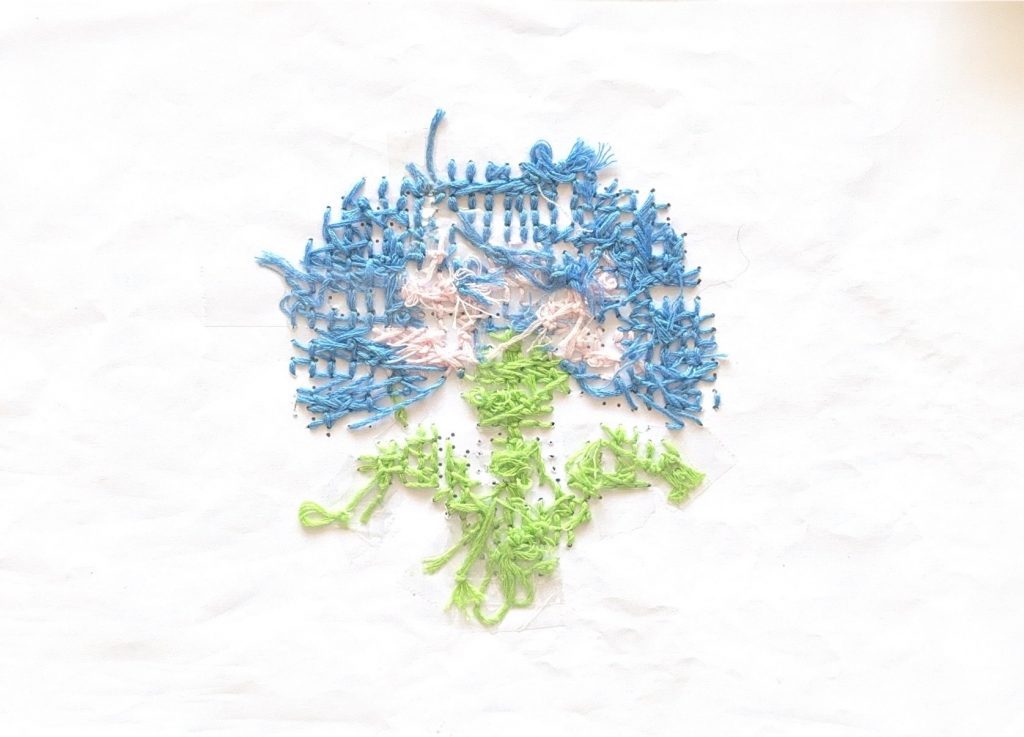
Additionally, something that came up was looking at the reverse side of the cross-stitch, I became interested in how it formed an image of its own. The loose threads, overlapping lines and irregular patterns created an unexpected composition that differed from the more controlled and structured image on the front. Although both sides are produced through the same process, they communicate something very different. The back reveals the physical process of making, where the threads become a network of marks that almost resemble an abstract drawing. The front is the intended image, but the back is an accidental image created through the process of making. Both are equally valid visually, even though only one was originally intended to be seen. This made me consider how an image can exist beyond its intended front-facing surface, and how the process of creating something can produce an entirely separate visual outcome.
Draft 1 !!
Copying an artist’s cross-stitch over a photograph showed me how strongly a structured, pixel-like process shapes an image. I worked freehand, so my stitches were less consistent than the original. Small differences in placement, spacing and tension changed how cohesive the image felt, and the paper limited me because it could tear. This raised my key questions: what does a grid-like process keep, hide or add when it is laid over an image? And do the imperfections of making by hand make an image feel more intimate, or do they distract from it?
The cross-stitch project raises these questions because each stitch behaves like a pixel. Small, repeated decisions accumulate into a picture, and the process stays visible. The stitches add texture and interruption that change what a viewer notices.
To explore this further, I will photograph a fence and translate it through different grid-based systems, including pixelation, ASCII characters and spreadsheet cells, as well as physical methods such as stamping and weaving. I will keep the source image constant so I can compare how each system changes what is legible and how the image is read.
REFERENCES
The Museum of Modern Art. (2016). Agnes Martin | MoMA. [online] Available at: https://www.moma.org/artists/3787-agnes-martin [Accessed 31 Oct. 2026].
Krauss, R. (1979) ‘Grids’, October, 9, pp. 50–64. Available at: http://www.jstor.org/stable/778321 (Accessed: 13 April 2009).
Leave a Reply